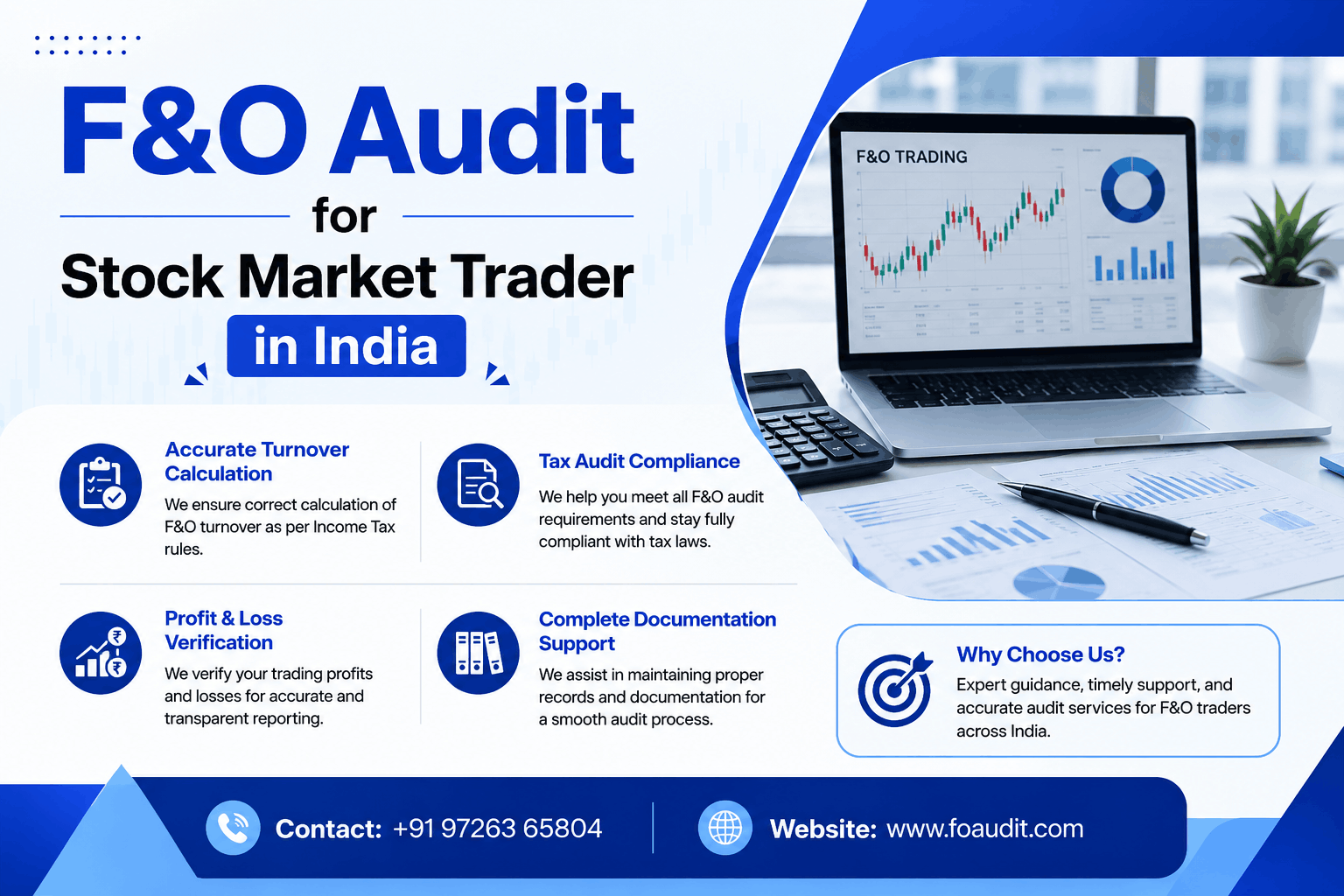
F&O Audit for Stock Market Trader in India
Welcome to our blog! Today, we will discuss F&O Audit for Stock Market Trader in India and why it is an important part of managing your trading activities responsibly. Futures and Options (F&O) trading has become increasingly popular among Indian traders due to the opportunities it offers to earn profits in different market conditions. However, along with trading opportunities come important tax and compliance responsibilities that every trader should understand. Since F&O trading is treated as a business activity under the Income Tax Act, traders may be required to comply with tax audit provisions depending on their turnover and income. An F&O audit helps ensure accurate reporting of trading profits and losses, proper maintenance of financial records, and compliance with income tax regulations. It also helps traders avoid penalties, notices, and complications during tax filing. Whether you are a beginner, part-time trader, or full-time market participant, understanding F&O audit requirements can help you stay compliant, make informed financial decisions, and focus on your trading journey with confidence.
What is an F&O Audit?
For Stock Market Traders involved in Futures and Options (F&O) trading, understanding tax audit requirements is an important part of staying compliant with income tax laws. Since F&O trading is classified as a business activity under the Income Tax Act, the income earned from such transactions is generally treated as business income. Depending on factors such as turnover, profit levels, and the tax regime chosen, traders may be required to maintain proper books of accounts and comply with tax audit provisions.
An F&O audit is conducted by a Chartered Accountant to verify the accuracy of trading records, turnover calculations, profit and loss statements, and other financial information reported in the income tax return. The audit helps ensure that stock market traders correctly disclose their trading income and comply with applicable tax regulations. It also minimizes the chances of errors, penalties, and notices from the Income Tax Department, making the tax filing process smoother and more transparent.
Importance of F&O Audit for Stock Market Traders
Stock market traders, an F&O audit is not just a legal formality—it is an essential part of managing trading activities and fulfilling tax obligations. Since Futures and Options (F&O) trading is treated as a business activity under the Income Tax Act, traders must ensure that their turnover, profits, losses, and expenses are reported accurately. An F&O audit helps verify financial records, improves transparency, and ensures that tax returns are filed correctly. It also helps traders maintain proper documentation, which can be useful in case of any future tax scrutiny or assessment.
A timely F&O audit can protect traders from penalties, notices, and compliance-related issues while making the tax filing process smoother. By reviewing trading transactions and financial statements, the audit confirms that all relevant information has been disclosed correctly. Whether you are a full-time trader or trade as a secondary source of income, an F&O audit can help you stay compliant with tax laws and manage your trading business more effectively.
Benefits of an F&O Audit for Stock Market Traders
- Ensures Compliance with Income Tax Laws and helps traders meet statutory requirements.
- Verifies Accurate Turnover Calculation based on prescribed tax audit rules.
- Confirms Correct Reporting of Profits and Losses in the income tax return.
- Reduces the Risk of Penalties and Notices from the Income Tax Department.
- Maintains Proper Financial Records for future reference and tax assessments.
- Improves Transparency and Credibility of trading-related financial information.
- Supports Smooth Tax Filing by ensuring all records are organized and accurate.
- Helps Avoid Costly Errors in income reporting and tax calculations.
Ensures Accurate F&O Turnover Calculation
Accurate turnover calculation is essential for every stock market trader involved in Futures and Options (F&O) trading. Many traders assume that F&O turnover is simply the total value of all buy and sell transactions, but this is not how turnover is calculated for income tax purposes. The Income Tax Department and professional accounting guidelines prescribe a specific method for calculating F&O turnover, making it important for traders to determine their turnover correctly before filing their tax returns.
An F&O audit helps verify turnover calculations and ensures that trading income is reported accurately. Incorrect turnover calculation can lead to the wrong assessment of tax audit applicability, errors in income reporting, and potential notices from the Income Tax Department. By reviewing trading records and applying the correct turnover calculation method, an F&O audit helps stock market traders remain compliant with tax laws, avoid costly mistakes, and file their income tax returns with greater confidence.
Why Accurate Turnover Calculation Matters
- Determines whether a tax audit is applicable
- Ensures correct reporting of trading income and losses
- Reduces the risk of tax notices and penalties
- Helps maintain compliance with income tax regulations
- Supports accurate and hassle-free tax filing
Helps Stock Market Traders Report Income and Expenses Correctly
Accurate reporting of trading income and expenses is essential for every stock market trader involved in Futures and Options (F&O) trading. With numerous transactions taking place throughout the year, it can be difficult to keep track of profits, losses, brokerage charges, taxes, and other trading-related costs. Even small errors in reporting can affect tax calculations and create compliance issues. An F&O audit helps traders maintain accurate financial records and ensures that all trading activities are properly reflected in their income tax returns.
An F&O audit reviews trading statements, verifies profit and loss figures, and checks whether all eligible expenses have been correctly recorded. It also helps traders claim legitimate business expenses such as internet bills, trading platform subscriptions, research and advisory fees, professional charges, and other costs incurred for trading activities. By ensuring accurate income reporting and proper expense claims, an F&O audit helps stock market traders file error-free tax returns, reduce taxable income where permitted, and stay compliant with income tax regulations.
Key Benefits for Traders
- Accurate reporting of trading profits and losses
- Proper recording of trading-related expenses
- Easy reconciliation of broker statements
- Reduced risk of tax filing errors
- Better tax planning and compliance
- Smooth and hassle-free income tax return filing
Who Needs an F&O Audit?
Not every stock market trader is required to undergo an F&O audit, but it becomes mandatory in certain situations under the Income Tax Act. The applicability of an audit depends on factors such as F&O turnover, declared profits, taxable income, and the tax scheme chosen by the trader. Since Futures and Options (F&O) trading is considered a business activity, traders must evaluate their financial records carefully to determine whether they fall under the tax audit provisions.
An F&O audit helps ensure that trading income, losses, expenses, and turnover are reported accurately in the income tax return. Traders who meet specific turnover or profit-related conditions may be required to get their accounts audited by a Chartered Accountant before filing their tax returns. Understanding whether an audit applies to your case is important because non-compliance can lead to penalties, notices, and unnecessary tax complications.
An F&O Audit May Be Required If:
- Your F&O turnover exceeds the prescribed audit limits.
- You opt for presumptive taxation and declare lower profits than required.
- Your turnover and income fall under tax audit provisions.
- Accurate verification of trading records is required for tax compliance.
- You need to comply with the audit requirements of the Income Tax Act.
Since tax audit applicability varies based on individual circumstances, traders should calculate their turnover correctly and review their financial position before filing their income tax returns. Consulting a tax professional can help determine whether an F&O audit is mandatory and ensure full compliance with tax regulations.
Risks of Ignoring F&O Audit for Stock Market Traders
For stock market traders, failing to comply with F&O audit requirements can lead to serious tax and compliance issues. When an audit is applicable but not completed on time, traders may face problems during income tax assessments and could be asked to justify their trading income, losses, and turnover calculations. Since Futures and Options (F&O) trading is treated as business income under the Income Tax Act, following audit rules is essential for accurate and transparent tax reporting.
An F&O audit ensures that all trading records, turnover figures, profits, and financial statements are properly verified before filing the income tax return. Without this compliance, stock market traders increase their chances of receiving tax notices, penalties, and closer scrutiny from the Income Tax Department. Timely completion of the audit helps traders stay compliant, avoid unnecessary legal complications, and maintain confidence in their tax filings.
Key Risks of Not Conducting an F&O Audit
- Penalties for violating tax audit provisions under income tax laws
- Increased chances of scrutiny and assessment by tax authorities
- Tax notices demanding clarification of trading income and records
- Difficulty in proving profit, loss, and turnover calculations
- Delays or issues in processing income tax returns
- Higher risk of errors and disputes in tax filing
- Loss of credibility in financial reporting as a stock market trader
Staying compliant with F&O audit requirements helps stock market traders avoid these risks and ensures smooth, stress-free tax filing.
Documents Required for F&O Audit for Stock Market Traders
For stock market traders, especially those involved in Futures and Options (F&O) trading, maintaining proper financial records is essential for a smooth and hassle-free tax audit process. A well-organized set of documents helps the Chartered Accountant verify trading income, turnover, expenses, and overall compliance with income tax regulations. Having these records ready in advance also reduces delays and ensures accurate reporting during the audit.
Important Documents Needed for F&O Tax Audit
- Broker profit and loss statements
- Trade books and detailed transaction reports
- Contract notes for all F&O trades
- Bank account statements linked to trading activity
- Demat account statements (if applicable)
- Expense bills and invoices (brokerage, software, advisory, etc.)
- Previous income tax returns (ITR copies)
- Form 26AS and Annual Information Statement (AIS)
Common Tax Filing Mistakes Made by F&O Traders
Stock market traders engaged in Futures and Options (F&O) trading often make avoidable mistakes while filing their income tax returns. Since F&O trading is treated as business income under the Income Tax Act, even small errors in reporting can lead to compliance issues, tax notices, or incorrect tax calculations. Understanding these common mistakes can help traders file accurate returns and stay compliant with tax regulations.
Common Errors in F&O Tax Filing
- Incorrect calculation of F&O turnover as per prescribed methods
- Treating F&O income as capital gains instead of business income
- Ignoring F&O tax audit applicability requirements
- Not maintaining proper trading and financial records
- Missing eligible business expense deductions such as brokerage, software, and advisory fees
- Filing income tax returns after the due date
- Failing to reconcile broker statements with tax records
Avoiding these mistakes helps stock market traders ensure accurate income reporting, reduce the risk of tax notices, and maintain smooth compliance with income tax laws. Proper record-keeping and correct classification of income are key to hassle-free F&O tax filing.
Conclusion: Importance of F&O Audit for Stock Market Traders
An F&O audit is essential for stock market traders as it ensures proper tax compliance, accurate turnover calculation, and correct reporting of profits and losses under income tax laws. It helps avoid penalties, notices, and filing errors while maintaining financial discipline in trading activities. By understanding audit requirements and keeping proper records, traders can ensure smooth tax filing and stay fully compliant with regulations while focusing on their trading journey.
Connect With Us for F&O Audit Support for Stock Market Traders
If you are a stock market trader dealing in Futures and Options (F&O) and need help with tax audit compliance, we are here to support you. Understanding F&O audit requirements, turnover calculation, and income tax filing rules can be complex, and professional guidance ensures accuracy and helps you avoid penalties, notices, and reporting errors. Our team provides complete assistance for F&O audit, including record checking, turnover calculation, profit and loss verification, and end-to-end tax filing support for traders.
📞 Contact: +91 97263 65804
🌐 Website: www.foaudit.com