F&O Trader Audit Applicability
Determining F&O Trader Audit Applicability is an important step for Futures & Options traders to ensure compliance with the Income Tax Act. The requirement for a tax audit depends on various factors such as turnover, profit or loss reported, maintenance of books of accounts, and the provisions applicable under Section 44AB. Since F&O trading is generally treated as a non-speculative business activity, traders must carefully evaluate their financial records and turnover calculations to determine whether a tax audit is required. Understanding the audit applicability criteria helps traders avoid penalties, ensure accurate tax reporting, and fulfill their compliance obligations in a timely manner.
Get Expert Assistance on Audit Applicability
When is Tax Audit Applicable for F&O Traders?
Tax audit applicability for Futures & Options (F&O) traders depends on several factors, including turnover, profit or loss reported, maintenance of books of accounts, and compliance with the provisions of Section 44AB of the Income Tax Act. Since F&O trading is generally treated as a non-speculative business activity, traders must calculate their turnover accurately and evaluate their financial results to determine whether a tax audit is required. The calculation of F&O turnover plays a crucial role in this assessment and is generally based on the absolute value of profits and losses, option premium received, and other prescribed adjustments. In addition, traders reporting lower profits, business losses, or intending to carry forward eligible losses should carefully review their audit obligations to ensure compliance with applicable tax provisions.
The applicability of a tax audit may also be influenced by factors such as the volume of trading transactions, use of multiple broker accounts, maintenance of books of accounts, and the overall nature of trading activities. Therefore, proper documentation, including broker statements, contract notes, trade reports, bank statements, and profit & loss statements, should be maintained throughout the financial year. A detailed review of trading records and financial statements helps determine audit applicability accurately, ensures correct reporting of trading income and losses, and minimizes the risk of penalties or compliance issues. Professional guidance from a Chartered Accountant can further assist traders in meeting their tax audit and Income Tax Return filing requirements efficiently.
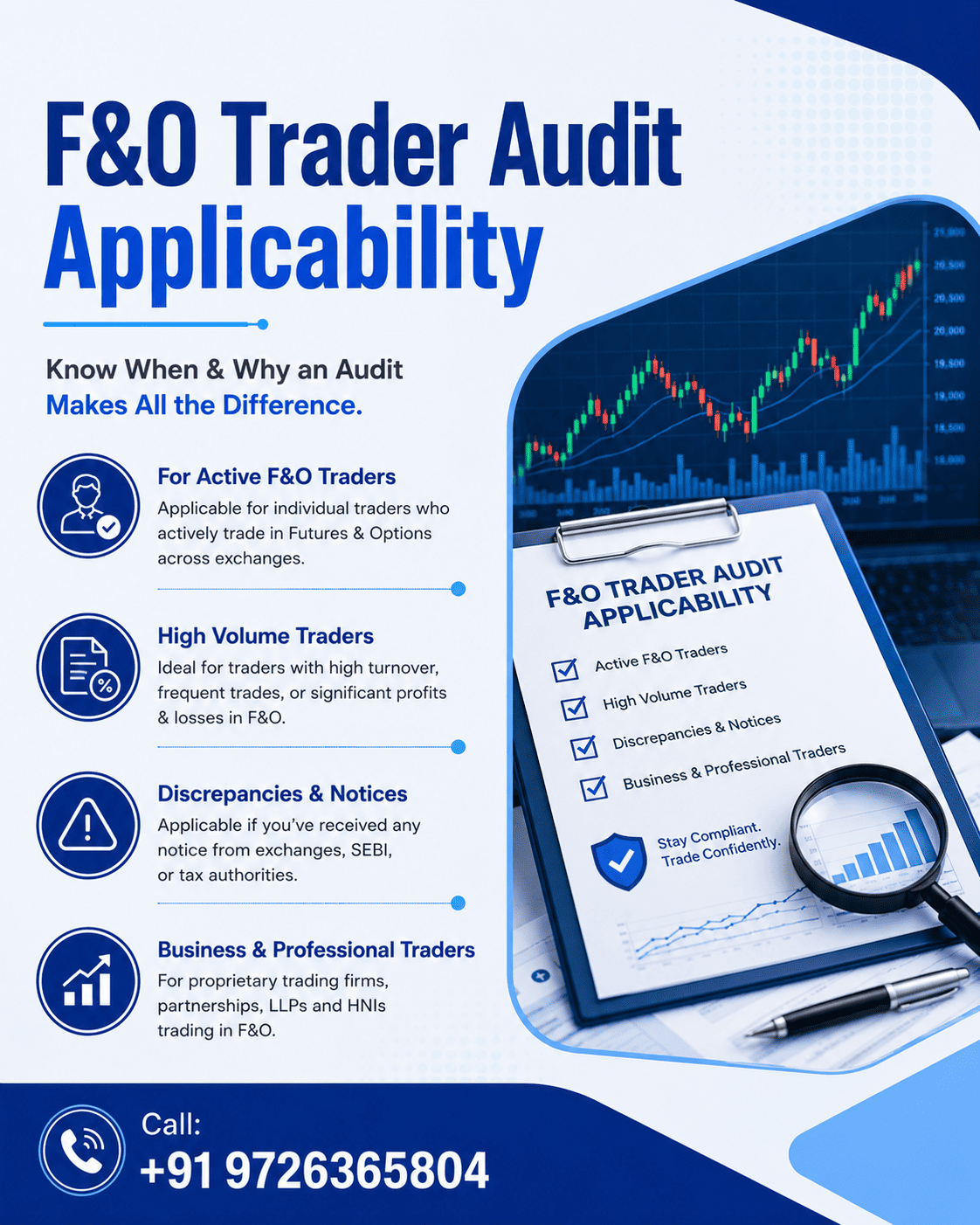
Futures & Options Audit Applicability Criteria
F&O Trading is Treated as Business Income under the Income Tax Act and is generally classified as a non-speculative business activity.
Turnover Calculation is the First Step in determining whether a tax audit is applicable. Turnover must be calculated as per ICAI guidance.
Tax Audit Applicability Depends on Turnover and the conditions prescribed under Section 44AB of the Income Tax Act.
Profit and Loss Position Must Be Evaluated to determine compliance with applicable tax provisions.
Maintenance of Books of Accounts may be required depending on turnover, income, and audit applicability.
Loss-Making Traders Should Review Audit Requirements carefully, as audit applicability may arise in certain situations.
Presumptive Taxation Provisions, where applicable, may affect audit requirements and compliance obligations.
Digital Transaction Limits and Conditions should be considered while assessing audit applicability.
Accurate Reporting of Trading Income is essential for determining audit eligibility and filing the correct Income Tax Return.
Broker Statements and Trading Records should be maintained to support turnover calculations and audit requirements.
Income from Other Sources such as salary, interest, rental income, or business income may also need to be considered during tax planning and return filing.
Proper Documentation and Record Keeping help ensure smooth audit completion and compliance with tax regulations.
Tax Audit Report Filing must be completed within the prescribed due dates if audit provisions are applicable.
Professional Review of Trading Activities can help determine the correct audit position and avoid compliance errors.
Timely Compliance with Income Tax Provisions helps traders avoid penalties and maintain accurate tax records.
Audit Applicability Based on Profit & Loss
| F&O Turnover | Profit / Loss Position | Tax Audit Applicability* |
|---|---|---|
| Up to ₹3 Crore* | Profit ≥ 6% of Turnover | Generally Not Required |
| Up to ₹3 Crore* | Profit < 6% of Turnover and Total Income exceeds Basic Exemption Limit | May Be Applicable |
| Up to ₹3 Crore* | Loss Reported and Total Income exceeds Basic Exemption Limit | May Be Applicable |
| Above Prescribed Limits | Any Profit or Loss Position | Audit Applicability to be Evaluated Under Section 44AB |
| Loss with Carry Forward Claim | Depends on Facts and Applicable Provisions | Professional Review Recommended |
Carry Forward and Set-Off of F&O Losses
F&O losses are generally treated as non-speculative business losses under the Income Tax Act.
Eligible F&O losses may be set off against other business income as permitted under tax provisions.
Unadjusted losses can generally be carried forward to future years subject to applicable conditions.
Timely filing of the Income Tax Return is important to preserve carry-forward benefits.
Proper computation and reporting of trading losses are essential for tax compliance.
Accurate F&O turnover calculation helps determine audit applicability and loss reporting requirements.
Traders should maintain broker statements, ledgers, and profit & loss reports as supporting documents.
Losses must be disclosed correctly in the Income Tax Return to claim future tax benefits.
Carry-forward losses may be adjusted against eligible business profits in subsequent years.
Proper books of accounts and financial records should be maintained for verification purposes.
Tax audit requirements, where applicable, should be complied with before claiming loss benefits.
Professional review can help ensure correct treatment of F&O losses and avoid reporting errors.
Proper documentation supports loss claims during assessments or scrutiny proceedings.
Compliance with income tax provisions helps maximize the benefit of eligible loss set-off and carry forward.
Timely tax planning can assist traders in utilizing carried-forward losses effectively.
Carry Forward and Set-Off of F&O Losses
F&O losses are generally treated as non-speculative business losses under the Income Tax Act.
Eligible F&O losses may be set off against other business income as permitted under tax provisions.
Unadjusted losses can generally be carried forward to future years subject to applicable conditions.
Timely filing of the Income Tax Return is important to preserve carry-forward benefits.
Proper computation and reporting of trading losses are essential for tax compliance.
Accurate F&O turnover calculation helps determine audit applicability and loss reporting requirements.
Traders should maintain broker statements, ledgers, and profit & loss reports as supporting documents.
Losses must be disclosed correctly in the Income Tax Return to claim future tax benefits.
Carry-forward losses may be adjusted against eligible business profits in subsequent years.
Proper books of accounts and financial records should be maintained for verification purposes.
Tax audit requirements, where applicable, should be complied with before claiming loss benefits.
Professional review can help ensure correct treatment of F&O losses and avoid reporting errors.
Proper documentation supports loss claims during assessments or scrutiny proceedings.
Compliance with income tax provisions helps maximize the benefit of eligible loss set-off and carry forward.
Timely tax planning can assist traders in utilizing carried-forward losses effectively.
Applicability of Presumptive Taxation Rules
Presumptive taxation is a simplified taxation scheme under Section 44AD of the Income Tax Act, 1961, designed to reduce the compliance burden for small businesses. Since income from Futures and Options (F&O) trading is generally treated as non-speculative business income, eligible F&O traders may opt for the presumptive taxation scheme subject to the prescribed conditions.
Under Section 44AD, taxpayers can declare a minimum of 6% of digital receipts (or 8% in certain cases) as their taxable income without maintaining detailed books of accounts. This eliminates the need for extensive record-keeping and simplifies tax filing procedures.
However, if an F&O trader declares profits lower than the prescribed presumptive rate and their total income exceeds the basic exemption limit, a tax audit may become applicable under Section 44AB. Therefore, traders should carefully evaluate their turnover, profit levels, and tax liability before opting for or opting out of the presumptive taxation scheme.
Cases Where Tax Audit Is Not Mandatory
A tax audit is generally not mandatory for F&O traders when their turnover remains within the prescribed limits and they comply with the applicable income tax provisions. Traders who opt for the presumptive taxation scheme and declare the required profit percentage may also avoid a tax audit. Additionally, if the conditions specified under Section 44AB are not triggered, there is no requirement to get the accounts audited. However, traders should accurately calculate turnover and maintain proper records to determine their audit applicability.
Disclaimer on Tax Law Amendments
Tax laws, audit thresholds, and compliance requirements are subject to change through amendments, notifications, and judicial rulings. The information provided is for general guidance only and may not reflect the latest legal developments. F&O traders should verify current provisions under the Income Tax Act or consult a qualified tax professional before making any tax-related decisions.