Futures and Options Audit by CA
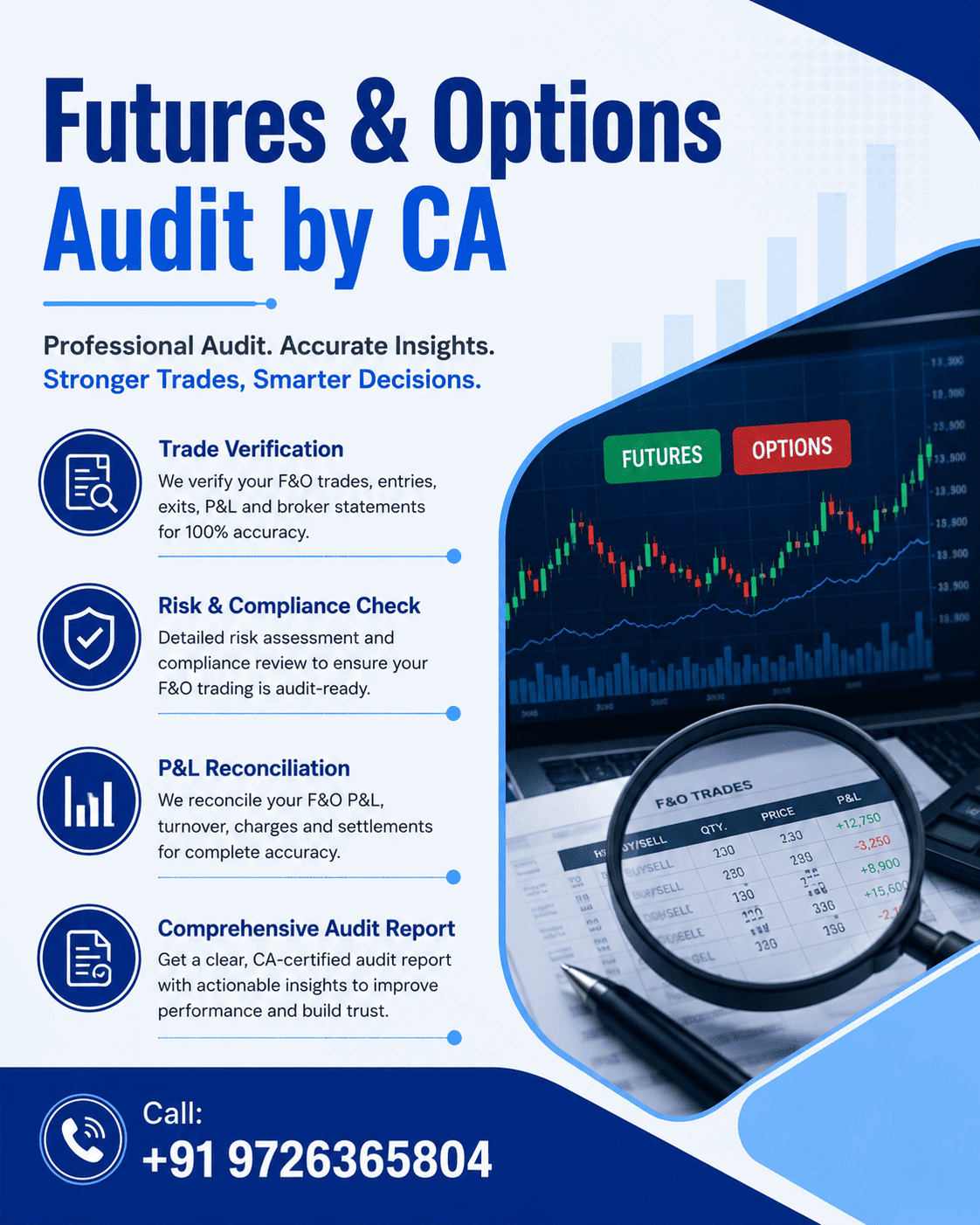
A Futures and Options Audit by CA is conducted to verify and certify the accuracy of trading transactions, profits, losses, and related financial records arising from derivative trading activities. Under the provisions of the Income Tax Act, taxpayers engaged in F&O trading may be required to undergo a tax audit if their turnover exceeds the prescribed limits or if they do not meet the specified conditions for presumptive taxation. The audit helps ensure proper maintenance of books of accounts, correct computation of turnover, compliance with tax regulations, and accurate reporting of income or losses from F&O transactions.
Request an F&O Audit Consultation !
F&O Trading Audit Services for Income Tax Compliance
Futures and Options Audit by CA plays a crucial role in ensuring that income earned or losses incurred from derivative trading activities are accurately reported under the Income Tax Act. Through a comprehensive review of trading records, broker statements, bank transactions, and financial documents, the correctness of turnover calculations and tax disclosures is verified. Moreover, compliance with applicable tax regulations is ensured, reducing the risk of notices, penalties, or assessment-related issues.
Furthermore, F&O trading is treated as a non-speculative business activity for taxation purposes, and therefore, specific audit requirements may be applicable depending on turnover, profit, and loss criteria. During the audit process, books of accounts are examined, trading data is reconciled, and financial information is validated to ensure accurate tax reporting. As a result, traders are provided with greater confidence that their tax returns are filed correctly and in accordance with legal requirements.
In addition, professional audit support helps identify discrepancies, maintain proper documentation, and streamline the tax filing process. Consequently, traders can focus on their investment strategies while tax compliance obligations are efficiently managed. Whether you are a retail trader or a high-volume derivatives investor, a Futures and Options Audit can help ensure transparency, accuracy, and full compliance with income tax regulations.
Who Needs an F&O Tax Audit?
An F&O (Futures and Options) Tax Audit may be required for traders under specific circumstances prescribed by the Income Tax Act. The following categories of traders generally need an audit:
Traders with High F&O Turnover
An audit may be required when the turnover from F&O trading exceeds the prescribed tax audit limits under the Income Tax Act.Traders Reporting Lower Profits
If profits are declared below the specified percentage of turnover and certain tax provisions are applicable, a tax audit may be mandated.Traders Opting Out of Presumptive Taxation
When a trader chooses not to follow the presumptive taxation scheme and reports lower income than the prescribed limits, an audit may be required.Traders Claiming Business Losses
F&O traders who incur losses and intend to carry them forward to future financial years should maintain proper records, and an audit may be applicable depending on their circumstances.Frequent or High-Volume Traders
Individuals executing a large number of derivative transactions may require an audit to ensure accurate turnover calculation and tax reporting.Partnership Firms and Business Entities
Firms and companies engaged in F&O trading may be subject to tax audit requirements based on their turnover and income levels.Traders Seeking Full Tax Compliance
A professional audit helps ensure that income, expenses, profits, and losses are reported correctly and in accordance with tax regulations.Traders Facing Income Tax Scrutiny Risks
Proper auditing and documentation can help reduce the likelihood of tax notices, penalties, and compliance issues.Individuals Maintaining Business Income from Trading
Since F&O income is generally treated as business income, traders must comply with the relevant accounting and audit requirements.Traders Requiring Accurate Turnover Calculation
A tax audit helps verify turnover, reconcile trading records, and ensure accurate filing of income tax returns.
By obtaining a Futures and Options Audit by CA, traders can ensure accurate financial reporting, proper documentation, and compliance with income tax laws while minimizing the risk of errors and penalties.
Income Tax Audit Applicability for F&O Trade
The applicability of an Income Tax Audit for F&O (Futures and Options) traders depends on factors such as turnover, profit levels, and compliance with the provisions of the Income Tax Act. Since income from F&O trading is generally classified as business income, traders are required to maintain proper books of accounts and comply with the relevant tax regulations. Therefore, determining whether a tax audit is applicable is an important part of tax planning and compliance.
Turnover-Based Audit Requirement
An income tax audit may be required when the turnover from F&O trading exceeds the prescribed limits under the Income Tax Act. The turnover is calculated using the method prescribed for derivative transactions.Low Profit Declaration
If a trader reports profits below the specified threshold and does not meet the conditions of presumptive taxation, a tax audit may become applicable.Business Income Classification
Since F&O trading income is treated as business income, the provisions relating to business audits and record maintenance are generally applicable.Loss-Making Traders
Traders reporting losses may also need to evaluate audit applicability, especially when they wish to carry forward eligible business losses to future assessment years.Maintenance of Books of Accounts
Proper books of accounts, broker statements, contract notes, and financial records should be maintained to support the figures reported in the income tax return.Verification of Turnover and Profit/Loss
During the audit process, turnover calculations, profits, losses, and expenses are reviewed and verified to ensure accurate tax reporting.Compliance with Income Tax Provisions
An audit helps ensure that all applicable tax provisions, disclosures, and reporting requirements are properly complied with.Reduction of Tax Risks
Accurate audit and documentation help minimize the risk of notices, penalties, and disputes arising from incorrect reporting of F&O transactions.Professional Certification by a Chartered Accountant
The audit is conducted by a qualified Chartered Accountant, through whom the financial records and tax computations are examined and certified as required.
A Futures and Options Audit by CA helps traders meet their tax obligations efficiently while ensuring transparency, accuracy, and compliance with the Income Tax Act.
Turnover Limits and Audit Requirements
| Criteria | Audit Requirement |
|---|---|
| F&O Income Nature | Treated as Business Income under the Income Tax Act. |
| Turnover Calculation | Based on the absolute value of profits and losses from F&O transactions. |
| High Turnover | Tax audit may be required if turnover exceeds the prescribed limits. |
| Low Profit Declaration | Audit may be applicable when profits are below the prescribed threshold and relevant conditions are not met. |
| Loss from F&O Trading | Audit applicability should be evaluated when losses are reported and carried forward. |
| Books of Accounts | Proper records, broker statements, and financial documents should be maintained. |
| Audit Purpose | To verify turnover, profits, losses, and tax compliance. |
| Professional Assistance | A Chartered Accountant helps determine audit applicability and ensures accurate reporting. |
Profit and Loss Statement Reconciliation
Profit and Loss Statement Reconciliation is an important part of the F&O audit process that helps ensure the accuracy of trading income, expenses, profits, and losses reported in financial records. During this process, trading statements, broker reports, bank transactions, and accounting records are reviewed and matched to identify any discrepancies. As a result, the financial information reported in the income tax return can be verified and validated.
Verification of Trading Income – All profits earned from Futures and Options transactions are reviewed and reconciled with broker statements.
Validation of Trading Losses – Reported losses are checked to ensure they are accurately recorded and supported by relevant documents.
Matching Financial Records – Trading reports, bank statements, and books of accounts are compared to confirm consistency and accuracy.
Identification of Discrepancies – Any differences between trading records and financial statements are identified and corrected.
Review of Expenses – Trading-related expenses are verified to ensure proper classification and reporting.
Accurate Tax Reporting – Reconciled profit and loss figures help ensure correct disclosure of income and losses in tax returns.
Improved Compliance – Proper reconciliation supports compliance with Income Tax Act requirements and audit standards.
Reduced Risk of Errors – A thorough review minimizes the chances of misreporting, tax notices, and penalties.
A Futures and Options Audit by CA includes detailed Profit and Loss Statement Reconciliation to ensure transparent financial reporting, accurate tax filings, and regulatory compliance.
Common Mistakes F&O Traders Should Avoid
F&O (Futures and Options) traders often make mistakes that can result in inaccurate tax reporting, compliance issues, and financial discrepancies. Common errors include incorrect turnover calculations, failure to maintain proper records such as broker statements and contract notes, misreporting of profits and losses, and inadequate reconciliation of trading transactions with financial statements. Additionally, some traders overlook tax audit requirements, miss income tax return deadlines, incorrectly classify F&O income, or fail to claim eligible trading-related expenses. Furthermore, insufficient documentation to support loss claims can create difficulties when carrying forward losses for future tax benefits. Therefore, maintaining accurate records, regularly reconciling financial data, and ensuring compliance with applicable tax regulations are essential for avoiding penalties and tax notices. A Futures and Options Audit by CA helps identify and rectify these issues, ensuring accurate financial reporting, proper documentation, and full compliance with income tax laws.
Why Choose a Chartered Accountant for F&O Audit Services?
Choosing a Chartered Accountant (CA) for F&O audit services ensures that your trading activities are reviewed accurately and in compliance with the Income Tax Act. Since Futures and Options trading involves complex turnover calculations, profit and loss reporting, and tax audit requirements, professional expertise is essential to avoid errors and ensure proper tax compliance. A Chartered Accountant can accurately determine audit applicability, verify trading records, reconcile financial statements, and prepare the necessary audit reports. Furthermore, discrepancies in trading data can be identified and corrected, while compliance with statutory requirements is ensured. As a result, the risk of tax notices, penalties, and reporting mistakes is significantly reduced. A Futures and Options Audit by CA also provides valuable guidance on record maintenance, loss carry-forward provisions, and tax return filing, helping traders achieve accurate financial reporting and hassle-free compliance.