F&O Income Tax Audit Process
The F&O Income Tax Audit Process involves reviewing trading transactions, turnover calculations, profits, losses, and financial records to ensure compliance with the Income Tax Act. During the audit, broker statements, contract notes, and bank records are verified to confirm accurate tax reporting. As a result, traders can meet tax obligations, reduce compliance risks, and ensure their income tax returns are filed correctly.
Get Expert Tax Audit Support
Understanding the F&O Income Tax Audit Process
Understanding the F&O Income Tax Audit Process is essential for traders who want to ensure accurate tax reporting and compliance with the Income Tax Act. The audit process involves a detailed review of trading transactions, turnover calculations, profits, losses, and supporting financial records to verify the accuracy of the information reported in the income tax return. Furthermore, broker statements, contract notes, bank statements, and other relevant documents are examined to identify discrepancies and ensure proper record maintenance. The applicability of a tax audit is also assessed based on turnover and other prescribed conditions. As a result, traders can meet their statutory obligations, reduce the risk of errors, notices, and penalties, and maintain transparency in their financial reporting. Professional assistance throughout the audit process helps ensure that all compliance requirements are fulfilled accurately and efficiently.
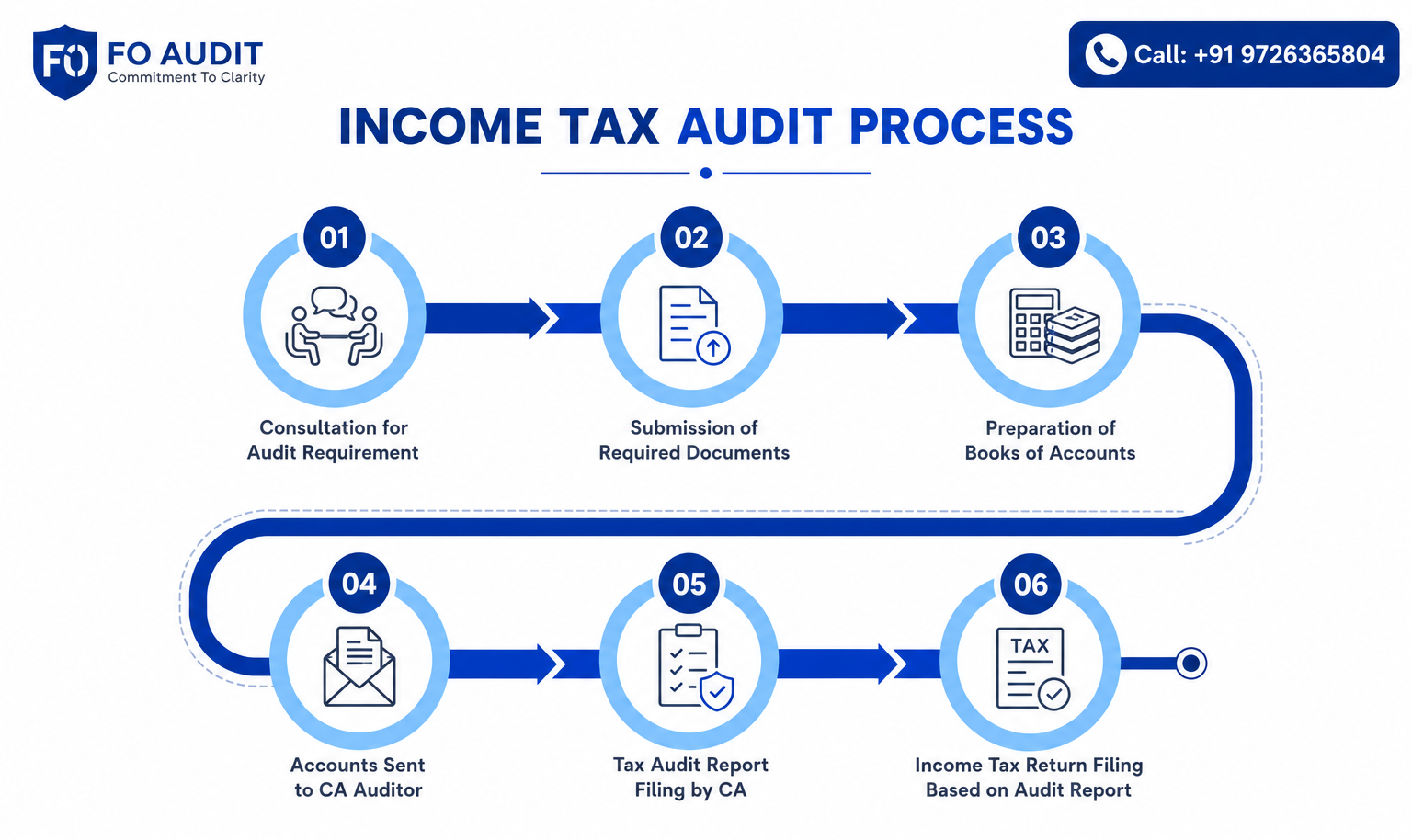
How the F&O Tax Audit Process Works
The F&O Tax Audit Process begins with the collection and review of essential trading and financial documents, including broker statements, contract notes, profit and loss reports, and bank statements. Once the records are gathered, F&O turnover is calculated using the prescribed method, and trading profits, losses, and expenses are verified for accuracy. Furthermore, the applicability of a tax audit is assessed based on turnover and other relevant provisions of the Income Tax Act. All financial information is then reconciled and examined to ensure that the figures reported in the income tax return are accurate and supported by proper documentation. Any discrepancies identified during the review process are addressed and corrected. Finally, the audit report is prepared and completed in accordance with statutory requirements, helping traders achieve accurate tax compliance and reduce the risk of notices, penalties, or reporting errors.
F&O Income Tax Audit Process – Step-by-Step Guide
The F&O Income Tax Audit Process is designed to ensure accurate financial reporting, compliance with tax regulations, and timely filing of audit reports and income tax returns. From assessing audit applicability to filing the final tax return, each step is carefully managed to provide traders with a smooth and hassle-free experience.
1. Consultation for Audit Requirement
The process begins with a detailed consultation to determine whether a tax audit is applicable based on your F&O turnover, profits, losses, and other relevant provisions of the Income Tax Act. Furthermore, the audit requirements and compliance obligations are explained to help you understand the process clearly.
2. Submission of Required Documents
Once the audit requirement is confirmed, the necessary documents are collected, including broker statements, contract notes, profit and loss reports, bank statements, and other financial records. These documents are reviewed to ensure that complete and accurate information is available for the audit.
3. Preparation of Books of Accounts
After receiving the documents, our team prepares and organizes the books of accounts by reconciling trading transactions, calculating turnover, and verifying profits, losses, and expenses. As a result, accurate financial records are created to support the audit process.
4. Accounts Sent to CA Auditor
The prepared books of accounts and supporting financial documents are then submitted to the Chartered Accountant (CA) Auditor. Furthermore, all relevant information is reviewed to ensure compliance with applicable tax and audit requirements.
5. Tax Audit Report Filing by CA
The CA Auditor conducts the audit, verifies the financial records, and prepares the required tax audit report. Once completed, the audit report is submitted electronically to the Income Tax Department in accordance with statutory deadlines and compliance requirements.
6. Income Tax Return Filing Based on Audit Report
After the audit report is filed, the Income Tax Return (ITR) is prepared based on the audited financial statements and audit findings. Finally, the return is reviewed, finalized, and filed with the Income Tax Department, ensuring complete compliance and accurate tax reporting.
Through this structured F&O Income Tax Audit Process, traders can ensure accurate turnover calculation, proper documentation, regulatory compliance, and hassle-free completion of their tax audit and income tax return filing requirements.
Preparing Financial Records for Audit
Preparing accurate financial records is a crucial step in the F&O income tax audit process. Traders should collect and organize all relevant documents, including broker contract notes, trade books, profit and loss statements, ledger reports, bank statements, and details of trading-related expenses. These records enable the auditor to verify turnover calculations, assess reported income, and confirm the accuracy of deductions claimed during the financial year.
It is also important to reconcile broker statements with bank transactions and maintain supporting documents for expenses such as internet charges, trading software subscriptions, and advisory fees. Properly maintained financial records help ensure smooth audit compliance, minimize discrepancies, and reduce the risk of notices or penalties from the Income Tax Department.
Verification of Business Expenses Claimed
During an F&O tax audit, the auditor verifies business expenses to ensure they are legitimate, properly documented, and related to trading activities. Key areas of verification include:
Review of brokerage charges and transaction costs.
Verification of internet and communication expenses used for trading.
Examination of trading software and platform subscription fees.
Validation of advisory, research, and consultancy expenses.
Review of office-related expenses, if applicable.
Cross-checking expenses with invoices, bills, and receipts.
Verification of payments through bank statements and financial records.
Ensuring expenses are incurred wholly and exclusively for business purposes.
Identification of any personal expenses incorrectly claimed as business expenses.
Confirmation that deductions comply with applicable income tax provisions.
Proper documentation and accurate record-keeping help support expense claims and facilitate a smooth tax audit process.
ICAI Guidelines for F&O Turnover Calculation
The Institute of Chartered Accountants of India (ICAI) has prescribed specific guidelines for calculating turnover in Futures and Options (F&O) trading for tax audit purposes. As per these guidelines:
The absolute value of profits and losses from all F&O transactions is considered while calculating turnover.
Profits and losses are added together without adjusting one against the other.
In options trading, the premium received on the sale of options is also included in turnover.
Any difference arising on the reverse trade or settlement of contracts forms part of turnover.
Turnover calculation is used to determine the applicability of tax audit under the Income Tax Act.
Accurate turnover computation is essential for assessing tax compliance and audit requirements.
Traders should maintain detailed trade records and broker statements to support turnover calculations.
Following ICAI guidelines helps ensure correct reporting of F&O turnover and reduces the risk of errors during tax audits and return filing.
Submission of Information to the Auditor
Once the financial records are prepared, F&O traders must submit all relevant information and supporting documents to the auditor for review. This includes broker statements, contract notes, profit and loss reports, bank statements, turnover calculations, and details of business expenses claimed during the financial year.
The auditor examines these records to verify income, expenses, and compliance with applicable tax provisions. Providing complete and accurate information helps streamline the audit process, reduces the likelihood of queries or discrepancies, and ensures timely preparation and filing of the tax audit report.
Keep Records Updated Throughout the Year
Maintaining updated records throughout the financial year can significantly simplify the F&O tax audit process. Traders should regularly record their transactions, reconcile broker statements with bank accounts, and preserve invoices, receipts, and other supporting documents for business expenses.
Consistent record-keeping helps ensure accuracy in turnover calculations, income reporting, and expense claims. It also reduces the risk of missing information during the audit, enabling smoother compliance and timely filing of tax returns and audit reports.