Documents Required for F&O Income Tax Audit
Proper documentation plays a crucial role in the successful completion of an F&O Income Tax Audit. Traders engaged in Futures & Options transactions are required to maintain and provide various financial and trading records to ensure accurate turnover calculation, profit and loss assessment, and compliance with applicable tax provisions. The documents required for an F&O income tax audit generally include broker statements, trade reports, contract notes, bank statements, PAN details, previous income tax returns, and other supporting financial records. Maintaining complete and accurate documentation helps facilitate a smooth audit process, reduces the risk of reporting errors, and ensures compliance with the requirements of the Income Tax Act.
Need Help with Audit Documentation?
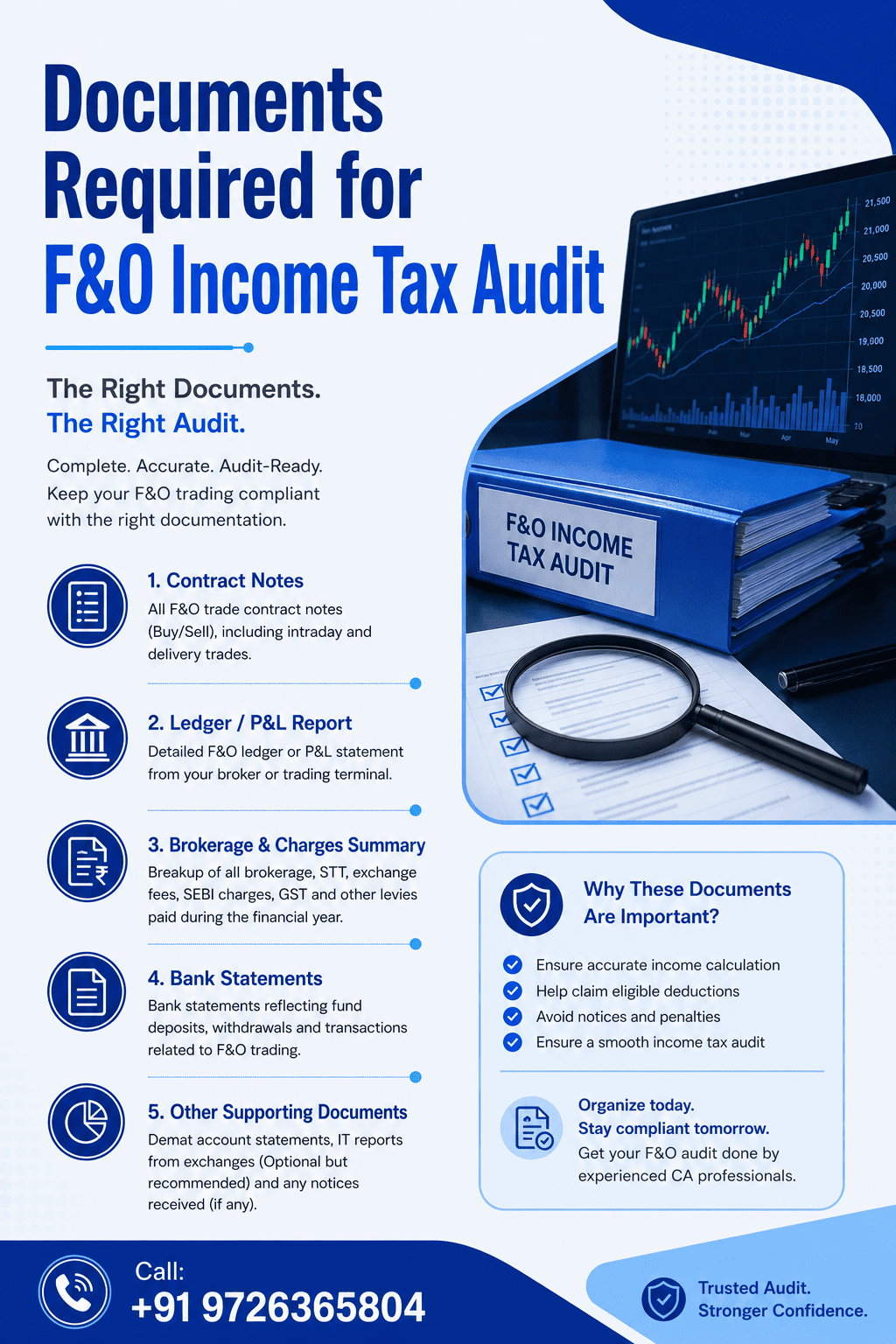
Required Documents for Futures & Options Tax Audit
To ensure accurate turnover calculation, tax audit compliance, and timely filing of your Income Tax Return, please keep the following documents and information ready:
- PAN Card & Aadhaar Card
- Bank Account Details & Statements
- Broker Ledger Statement
- F&O Transaction Statement
- Profit & Loss Report (Broker)
- Capital Gain / Tax Report
- Demat Holding Statement
- Investment Details
- Trading Expense Details
- Other Income Details (if any)
Financial Documents Required for Tax Audit
Financial documents play a crucial role in the Income Tax Audit process as they help the auditor verify the accuracy of the financial statements and assess compliance with the provisions of the Income Tax Act. Businesses and professionals undergoing a tax audit under Section 44AB must maintain and provide complete financial records for the relevant financial year.
The following financial documents are generally required for a tax audit:
Profit & Loss Account
Balance Sheet
Trial Balance
Cash Book and Ledger Accounts
Bank Statements for all business accounts
Sales and Purchase Registers
Expense Vouchers and Bills
Debtors and Creditors Statements
Fixed Asset Register
Loan and Investment Statements
GST Returns and Reconciliation Statements
TDS/TCS Records and Tax Payment Challans
These documents enable the tax auditor to verify business transactions, assess taxable income, identify discrepancies, and ensure that the financial records accurately reflect the business’s financial position. Maintaining organized and up-to-date financial documents not only simplifies the audit process but also helps avoid penalties, notices, and compliance issues during tax assessments.
Books of Accounts Required for Income Tax Audit
Proper maintenance of books of accounts is essential for businesses and professionals subject to an Income Tax Audit under Section 44AB of the Income Tax Act. These records provide a detailed account of all financial transactions and help the tax auditor verify the accuracy of income, expenses, assets, liabilities, and tax compliance.
The following books of accounts are generally required during a tax audit:
Cash Book
General Ledger
Journal Register
Purchase Register
Sales Register
Bank Book
Petty Cash Book
Inventory or Stock Register
Debtors and Creditors Ledger
Fixed Asset Register
Expense Registers and Supporting Documents
Payroll and Salary Records (if applicable)
These books of accounts help the auditor examine the financial activities of the business, reconcile transactions, and ensure that the reported income and expenses are supported by proper documentation. Accurate and regularly updated accounting records also reduce the risk of errors, tax disputes, penalties, and scrutiny from the Income Tax Department.
Businesses should maintain these records throughout the financial year and retain them for the prescribed period as required under the Income Tax Act. Proper bookkeeping not only facilitates a smooth tax audit process but also provides valuable insights into the financial health and performance of the business.
Information Included in Ledger Accounts
Ledger accounts serve as the foundation of a business’s accounting system by providing a detailed record of all financial transactions categorized under specific accounts. During an Income Tax Audit, ledger accounts help auditors verify the accuracy of financial records, identify discrepancies, and ensure compliance with tax regulations.
A ledger account typically includes the following information:
Date of each transaction
Transaction description or narration
Voucher or reference number
Debit and credit entries
Opening and closing balances
Details of customers, suppliers, or related parties
Expense and income classifications
Tax-related entries, including GST and TDS adjustments
By reviewing ledger accounts, tax auditors can trace individual transactions, reconcile balances with supporting documents, and confirm that all income and expenses have been properly recorded. Well-maintained ledger accounts also facilitate the preparation of financial statements, tax returns, and audit reports.
Businesses should regularly update and reconcile their ledger accounts to ensure accuracy and transparency. Proper ledger maintenance not only simplifies the Income Tax Audit process but also helps in identifying financial irregularities and improving overall financial management.
Importance of Maintaining Accurate Records
Maintaining accurate financial records is essential for businesses and professionals undergoing an Income Tax Audit under Section 44AB of the Income Tax Act. Proper record-keeping ensures that all financial transactions are correctly documented, making it easier to prepare financial statements, calculate taxable income, and comply with tax regulations.
Accurate records help tax auditors verify the authenticity of income, expenses, assets, liabilities, and tax-related transactions. They also reduce the likelihood of errors, omissions, and discrepancies that could lead to penalties, notices, or additional scrutiny from the Income Tax Department.
Some key benefits of maintaining accurate records include:
Simplifies the Income Tax Audit process
Ensures compliance with tax laws and regulations
Supports claims for deductions, exemptions, and depreciation
Helps identify and correct accounting errors promptly
Improves financial transparency and business decision-making
Facilitates smooth preparation of financial statements and tax returns
Reduces the risk of tax disputes and assessments
Businesses should maintain updated books of accounts, supporting invoices, bank statements, tax records, and other financial documents throughout the financial year. Consistent and organized record-keeping not only ensures a hassle-free tax audit but also strengthens the overall financial health and credibility of the business.
Turnover Calculation Documents for F&O Tax Audit
These are documents used to calculate and verify F&O turnover for income tax purposes. They include:
Broker P&L Statement
Tax P&L / Tax Report
Trade Book or Order Book
Contract Notes
Ledger Statement
Annual Transaction Summary
Bank Statements
These documents help determine F&O turnover, verify profit/loss, and assess whether a tax audit is applicable under the Income Tax Act.
Download the Complete F&O Tax Audit Document List
Download our complete F&O Tax Audit Document List to ensure you have all the necessary records ready for a smooth and hassle-free audit process.
Common Mistakes in Bookkeeping During Tax Audit
One of the most common challenges faced during an Income Tax Audit is inaccurate or incomplete bookkeeping. Many businesses fail to record transactions regularly, misclassify expenses, overlook supporting documents, or neglect bank and GST reconciliations. These errors can create discrepancies in financial statements and make it difficult for auditors to verify the accuracy of the records. Inadequate bookkeeping may also lead to incorrect tax calculations, delayed audit completion, and potential compliance issues under Section 44AB of the Income Tax Act. To ensure a smooth tax audit process, businesses should maintain updated books of accounts, preserve all financial documents, and perform regular reconciliations throughout the financial year. Proper bookkeeping not only helps meet statutory requirements but also improves financial transparency and supports informed business decision-making.